This section brings together short quotations from authors who have explored, directly or indirectly, the themes at the heart of the DARE project: health, prevention, time, care, technology, and the human condition. These are not merely literary embellishments, but prompts for reflection that invite us to look at the present with fresh eyes, finding in the conciseness of the aphorism a key to understanding—and sometimes rethinking—the world we live in.
“I’ve always been struck by this thing about paintings. They hang on walls for years, and then, without anything happening, absolutely nothing, bam, down they fall. They hang there on their nail, nobody does anything to them, but at a certain point, bam, they fall, like stones. In absolute silence, with everything around them perfectly still, not a fly in sight, and then, bam. There’s no reason for it.
Why at that very moment? Nobody knows. Bam.
What happens to a nail that makes it decide it can’t take it anymore? Does it have a soul, poor thing? Does it make decisions? Has it discussed it at length with the painting? Were they uncertain about what to do, talking about it every evening for years, until they finally agreed on a date, an hour, a minute, an instant—and that’s it, bam?
Or had the two of them known it from the very beginning? Had it all been arranged? ‘Look, I’m going to let go of everything in seven years.’ ‘That works for me.’ ‘Okay, then, we’ll say May 13, around a quarter to six.’ ‘Agreed. Good night.’ ‘Night.’
Seven years later, May 13, a quarter to six: bam.”
Alessandro Baricco, Novecento: A Monologue, Feltrinelli, Milan, 1994
In Novecento, Alessandro Baricco tells the story of a painting that hangs on a wall for years before suddenly falling, apparently for no reason: bam. It is an image that also speaks to the idea of prevention. When a disease manifests itself, when a fall occurs, or when a vulnerability becomes apparent, we tend to see that moment as the beginning of the event. Yet what we observe is often only the visible outcome of a process that began much earlier.
DARE also stems from this question: can we identify the early warning signs—subtle or extremely subtle—that precede such an outcome? Data, sensors, and artificial intelligence promise to make trajectories and vulnerabilities visible before they produce symptoms. But this possibility raises equally important questions: how far in advance do we want to know? What does it mean to live with the knowledge that a risk may never materialise? And is everything we can predict also useful—and desirable—to predict?
Perhaps prevention is precisely the effort to understand what may happen before that bam, without forgetting that knowing the future, even in terms of probabilities, inevitably changes the way we live in the present.
Who is the author
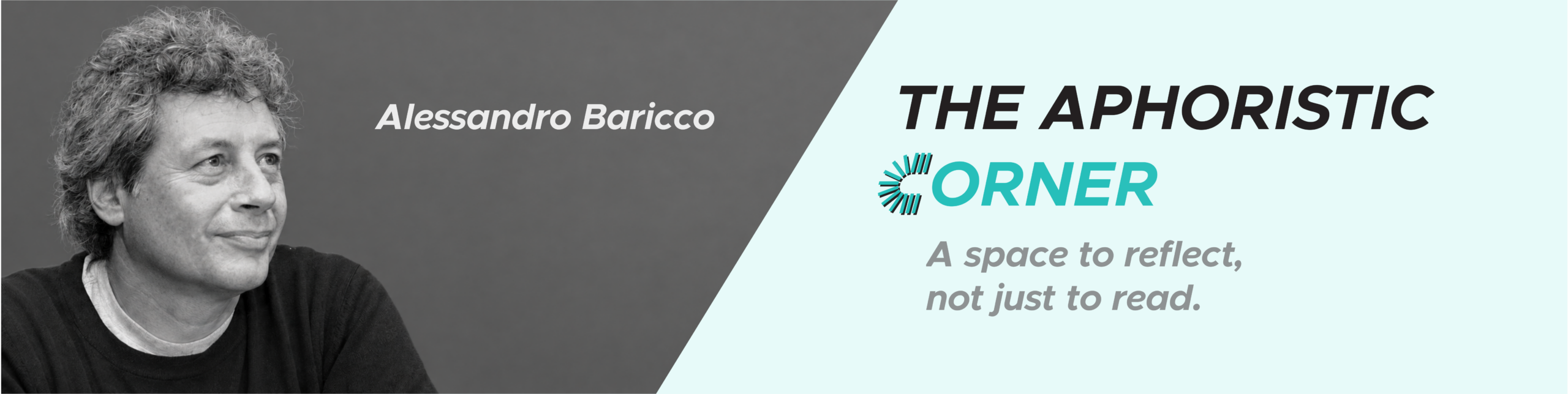
Alessandro Baricco (1958) is an Italian writer, essayist, and playwright, and one of the best-known figures in contemporary Italian literature. He has reached a wide readership with works such as Castelli di rabbia, Oceano mare, Seta, and Novecento: A Monologue, characterised by an evocative writing style that weaves storytelling together with reflections on the human experience. The excerpt featured here comes from Novecento: A Monologue (1994). Through the striking image of a painting that suddenly falls after hanging motionless for years, Baricco explores the relationship between time, change, causality, and unpredictability—themes that take on particular significance when considered in light of the possibilities and limitations of prediction and prevention.