To develop an integrated approach based on a datalakehouse infrastructure. The project proposal is based on the need for Data oriented IRCCS to equip themselves with technological platforms suitable for supporting the monitoring processes and planning support both in terms of clinical research and in terms of organizational research.
In particular, the project will focus on the development and testing of new IT/information tools to support clinical and research activity capable of standardizing data and providing forecasting and management algorithms with a particular focus on the of Datalakehouse for assistance and research data analysis, analytical ecosystem preparation and standard definition for the implementation of Advanced Analytics algorithms.
Sample size: Patients admitted in Emergency Department and as Inpatients to the IRCCS University Hospital of Bologna Policlinico di Sant'Orsola in occasion of epidemics spread or extreme climate conditions especially considering patients with frailty conditions.
This pilot project aims to improve fall risk assessment in elderly individuals by focusing on muscle power and motor control degradation, which are believed to be more predictive of falls than muscle strength alone.
The study will use a combination of experimental methods—including isometric and isokinetic dynamometry, gait analysis, and wearable sensors—and in silico tools such as digital twins and musculoskeletal modeling.
The goal is to develop and validate a clinically applicable protocol that quantifies muscle power, strength, and motor control. This approach will help identify older adults at high risk of falling, particularly those with or without knee osteoarthritis.
Data from experimental tests and imaging (e.g., MRI) will be collected and integrated with simulation models to inform clinical decision-making. The study is ambispective and observational, involving follow-ups over 24 months.
Expected outcomes include improved predictive accuracy of fall risk, a robust data collection framework, and a secure, open-access data platform. The project aligns with Italy’s National Recovery and Resilience Plan (PNRR), targeting advancements in preventive and personalized medicine.
To identify novel patterns of risk factors associated with non-communicable diseases among the elderly:
Sample size: between 500,000 and 700,000 elderly population in Europe.
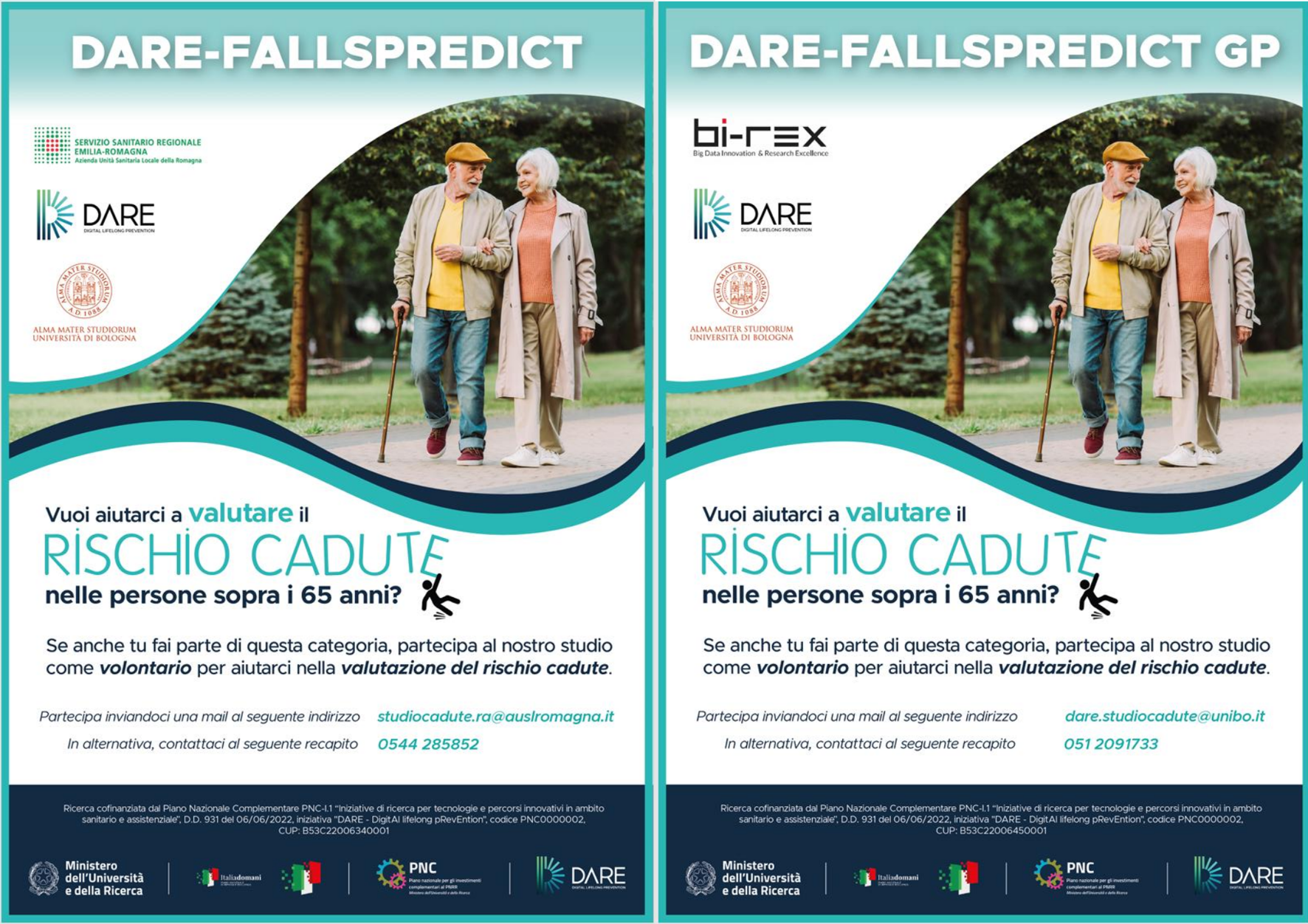
The pilot project FALLSPREDICT aims to develop a tool capable of estimating the risk of falls in older adults, both frail and non-frail, following hospital discharge as well as in the general population.
The tool will be fed with demographic and clinical data, as well as data collected from wearable sensors that monitor mobility, sleep, and heart rate, providing risk estimates on an annual and semi-annual basis.
FALLSPREDICT, either on its own or in combination with other tools used to estimate fracture risk following a fall, can support healthcare professionals in optimally allocating limited resources for fall prevention and mitigation. It will also provide valuable insights into key functional domains (mobility, sleep, and heart rate) in the daily lives of older adults.
The pilot project includes a main study (DARE-FALLSPREDICT study) and satellite studies (DARE-FALLSPREDICT GP and LOOKING-GLASS studies) to explore various aspects of the practical and technical feasibility of procedures involving the integrated use of multiple wearable sensors.
Osteoarthritis afflicts a considerable percentage of the population and, over time, disables the affected individual in common motor activities. In patients with degenerative processes still in the early stages, knee osteotomy is intended to realign the joint so as to slow the progression of osteoarthritis and, thus, delay or even eliminate the need for knee replacement. Standard preoperative planning of osteotomies is generally based on simple radiographs. With innovative three-dimensional analysis, advanced medical imaging techniques, and biomechanical modelling, it is now possible to perform such planning in a more accurate and personalised manner. The main goal of this pilot project is to arrange an accessible platform for “smart” planning of personalised knee osteotomies. Relevant patient-specific information, such as imaging, anatomical modelling, and device design, will be integrated into a single tool, the operability of which will be tested by a select group of Rizzoli Orthopaedic Institute surgeons scattered throughout the country. Last but not least, it is expected that the use of such a digital platform can be extended to other types of surgeries, including those of other anatomical compartments, supporting the use of three-dimensional printing in the customisation of orthopaedic treatments.

The project aims to develop methodologies providing insights about the progression of two major conditions affecting the knee joint. Specifically, the project focuses on studying: the progression of osteoarthritis, 1) assessing whether its advancement can be monitored since the early stages, 2) and joint prosthesis failure, representing the final treatment option in cases of end-stage osteoarthritis, but still with sub-optimal performance.
To investigate such relevant clinical issues, in silico models will be developed based on clinical imaging and key features of the prosthesis. Depending on the specific condition, the models will be driven either by evidence obtained through targeted motor tasks or by international standards. An in vitro study performed on knee tissues collected from patients undergoing total knee arthroplasty will further explore the impact of osteoarthritis on the functionality of these tissues, with particular focus on articular cartilage.

Neurodegenerative diseases, including Alzheimer’s and Parkinson’s disease, are preceded by a long prodromal phase, which represents the best therapeutic window but whose diagnosis is difficult. In this pilot we will focus on prodromal patients with a high conversion rate to overt neurodegenerative diseases (patients with subjective cognitive decline, mild cognitive impairment, Down syndrome, REM behaviour sleep disorder).
We plan to develop multimodal markers to predict the risk and time to conversion from prodromal conditions to overt neurodegenerative diseases.
These markers will include clinical data (instrumental measurements, clinical scales), neuropsychological data (neuropsychological scales, caregiver questionnaires), imaging data, biological data (blood test results, biomarkers of neurodegeneration measured in peripheral tissues and biological fluids, omics).
Overall, this project will promote the development of non-invasive and low-cost screening strategies for the early diagnosis of neurodegenerative diseases.

Diabetes mellitus (DM) affects approximately 530 million people worldwide. The foot and locomotor system can be severely affected (in about 20% of these patients), and the associated treatment costs for healthcare systems are substantial. Due to the risk of ulceration, it is crucial to identify all potential predisposing factors so that both patients and healthcare professionals can immediately adopt protective measures.
Modern multi-instrumental assessments—such as plantar pressure analysis, joint kinematics, and weight-bearing 3D radiographic scans—can now more effectively support prevention as well as early and personalised care, particularly through the identification of new biomechanical-based biomarkers.
The study evaluates two distinct populations of patients with type 2 DM:
I) those without any ulcerative lesions, and
II) those who have already developed such lesions.
Clinical and metabolic data will be collected at Sant’Orsola Hospital in Bologna, biological and biochemical data at Maria Cecilia Hospital in Cotignola, and biomechanical and functional data at the IRCCS Rizzoli Orthopaedic Institute in Bologna.
The primary objective is to correlate all collected data with the risk of foot ulceration. The secondary objective is to create a reference database on the metabolic conditions and structural and dynamic alterations of the diabetic foot in relation to ulceration risks.
This will allow for a detailed and quantitative monitoring of disease progression and enable early identification of potential foot complications.
The pilot study “Accessible Measurements of Mobility and Deformity as Biomarkers for Orthopaedic Treatments (MAMBO)" is being conducted at the IRCCS Istituto Ortopedico Rizzoli in Bologna. The project is coordinated by the research teams of the "Movement Analysis and Functional Evaluation of Prostheses" laboratory and of the "Rare Skeletal Diseases" unit. The primary objective of the study is the functional and morphological characterisation of Multiple Osteochondromas, a rare musculoskeletal disorder marked by the development of benign osseocartilaginous tumours on the bone surface. These bony lumps may result in functional and postural impairments of the musculoskeletal system.
The characterization of Multiple Osteochondromas is performed using state-of-the art sensors such as: IMU sensors, to measure joint mobility and quantify motor deficits; Pressure platforms, to assess plantar pressure distribution; Full-body 3D scanners, to assess the skeletal and postural alterations. In addition, the pilot also aims at evaluating experimental protocols, based on operator-independent instrumentation, for patient monitoring in community and outpatient settings.
Adopting a holistic approach, MAMBO integrates morphological and postural evaluations, offering clinicians a more comprehensive understanding of the patient’s overall condition and the progression of the disease over time. Furthermore, the study defines functional parameters that can serve as prognostic and predictive factors for the clinical and surgical management of patients with this rare disease, as well as others with similar pathogenic mechanisms.
The FASTK-II study is aimed at athletic and physically active patients aged between 40 and 65 who have stopped participating in sports due to knee osteoarthritis and are candidates for total knee replacement surgery.
The objective is to assess the preoperative neuromuscular condition of individuals with a long history of sports participation, while also analysing clinical and functional outcomes after surgery and the degree of return to sports activity.
The trial includes a preoperative assessment and monitoring during routine postoperative follow-up visits at 1, 3, 6 and 12 months. After surgery, patients will follow an intensive and personalised rehabilitation programme, initially as inpatients and subsequently in an outpatient or home-based setting.
Eligible participants are individuals aged between 40 and 65, diagnosed with knee osteoarthritis, indicated for total knee replacement, and willing to resume sports activity.
FASTK-II aims to define more personalised rehabilitation pathways, promoting functional recovery and a safe return to sport.

Background: Immediate postnatal skin-to-skin contact (SSC) has beneficial effects on maternal and neonatal health. However, the first two hours after birth represent a critical period for the occurrence of Sudden Unexpected Postnatal Collapse (SUPC), which may result in neonatal intensive care admission, encephalopathy, or death. To date, prevention of these events relies on regular clinical monitoring, especially during skin-to-skin contact (SSC).
Aim: The use of a wearable, non-invasive monitoring system during the first 48–72 hours of life could facilitate the early detection and timely management of episodes that could result in SUPC.
Design: Controlled, non-randomized, single-center study using a post-market medical device (Comftech HOWDY-BABY - ComfTech s.r.l.), which monitors heart rate and respiratory rate.
Target population: All newborns considered suitable for SSC/rooming-in according to routine clinical practice and fulfilling all of the following inclusion criteria: gestational age ≥ 35 weeks, Apgar score ≥ 8 at 5 minutes after birth, and written parental consent.
Outcomes: (1) Number of events preceding SUPC (bradycardia, bradypnea, and apnea) detected by the device; (2) Assessment of device tolerability; (2) Incidence of exclusive breastfeeding in newborns monitored with the device compared with those undergoing standard clinical monitoring; (3) Incidence of SUPC episodes.
Main results (expected): (1) Early recognition and management of episodes that may precede a SUPC, outside of the standard steps of the “traditional” monitoring; (2) To verify the level of tolerability of the device by the newborns/mothers.

Background: Family-Centered Care (FCC) improves the quality of life (QOL) of both newborns and their families during prolonged hospitalization. Although e-health and telemedicine offer considerable potential to improve outcomes and provide family support, their implementation across Europe remains limited.
Aim: The adoption of a new integrated approach combining FCC and e-health for the home management of newborns requiring low-intensity care may reduce hospital length of stay and improve QoL, ultimately enhancing the efficiency and sustainability of the healthcare system.
Design: Observational, prospective, single-center study, with a historical comparison cohort and with a post-market medical device (Comftech HOWDY-BABY, OXY-10 pulse oximeter, dedicated smartphone/mobile Comftech application, MHP telemonitoring platform - Mediaclinics S.r.l., Margherita 3 medical system)
Popolazione target: Neonati ex-pretermine e a termine con i seguenti requisiti: (1) presenza di un caregiver con competenze informatiche; condizioni abitative adeguate, assenza di fattori di rischio socio-ambientali, (2) stabilità delle condizioni cliniche generali, (3) consenso scritto dei genitori.
• Main outcomes (expected): (1) Improvement in the QoL and well-being of newborns and their families, including a reduction in the psychological distress associated with prolonged hospitalization; (2) Optimization of healthcare resources, potentially through a reduction in hospital length of stay (with consequent decrease in the risk of nosocomial infections and other hospitalization-related complications,) as well as lower rates of hospital readmission; (3) Providing evidence to support the broader adoption of e-health and telemedicine as effective tools for facilitating the transition from the NICU to home care.

Lung cancer is the leading cause of oncologic death worldwide. Evidence on the reduction of lung cancer mortality through secondary prevention using low-dose computed tomography (LDCT) has been generated by studies demonstrating that LDCT enables the detection of lung cancer at an early stage in high-risk individuals.
This pilot aims to implement a highly digitalized, artificial intelligence (AI)-supported lung cancer screening program, including:
This screening program is designed to optimize workflows, ensuring high-quality screening pathways and effective multidisciplinary coordination. The expected impact is clinical, economic, and social, contributing to a reduction in disease-related costs and facilitating the adoption of preventive strategies.

The Emilia-Romagna Inflammatory Bowel Disease (IBD) hub&spoke infrastructure will be developed further to allow for continuous quality of care assessment, research facilitation, timely alerting on clinical pathway management, benchmarking, and patient engagement.
The goal of the project is to create a data collection tool on the management of patients with inflammatory bowel disease that is self-implemented by data coming from routine healthcare activity or from data entered directly by patients through a self-reporting system. This system, inserted in a hub-spoke network, will allow not only the collection of real-life data on a large cohort of patients, but also to carry out internal and external evaluation/validation of clinical performance and correction of critical issues.
The collection of data from routine healthcare activity, including the time factor as a principal determinant, will allow for the identification of predictive factors of unfavorable evolution of disease or of ineffectiveness of treatment. The identification of predictive factors of ineffectiveness of treatment or development of disability will enable the modification of current therapeutic schemes proposed by current guidelines and to evaluate their effectiveness.

The pilot study aims to develop a personalized decision-support tool for predicting the risk of femoral fracture in patients with bone metastases.
Bone metastases can significantly compromise the mechanical strength of bone, increasing the risk of pathological fractures, which involve the femur in approximately 70% of cases. Currently, fracture risk assessment is primarily based on the Mirels’ score combined with clinical judgment. Although this approach represents the current gold standard, it is characterized by limited specificity. In this context, patient-specific models developed from CT images offer a more accurate method for estimating fracture risk. These models can support clinical decision-making by helping identify patients who may benefit from prophylactic surgical treatment and by guiding the selection of the most appropriate therapeutic strategy. Mirels’ score integrato con l’esperienza dei clinici, approccio che rappresenta il gold standard ma che è caratterizzato da una specificità limitata. In questo contesto, modelli paziente-specifici sviluppati a partire da immagini TC, costituiscono uno strumento più accurato per la stima del rischio di frattura. Tali modelli possono supportare il processo decisionale clinico, contribuendo all’identificazione dei pazienti che potrebbero beneficiare di un trattamento chirurgico profilattico e alla scelta della strategia terapeutica più appropriata.
The study will use clinical data collected at the Rizzoli Orthopaedic Institute between 2004 and 2023 to create personalized virtual models of the femur and simulate fracture risk associated with the presence of bone metastases. The results of these simulations will be used to identify patients at higher risk of fracture. Subsequently, the reliability of the method will be evaluated in a new group of patients to assess its usefulness in clinical practice.
The expected outcomes include the development of a tool capable of helping physicians more accurately distinguish between patients at high and low risk of fracture. In addition, an artificial intelligence–based system will be developed to automatically analyze femoral CT images, making the process faster and more efficient.

Sleep is an under-investigated field as we get older. In the real world, poor sleep can contribute to accelerating the ageing processes of both body and mind, leading to a loss of muscle mass and strength (sarcopenia), changes in metabolism, reduced bone health and cognitive decline.
The SOMNUS-DARE project was launched to better understand the extent to which sleep disorders affect ageing and the risk of developing physical and/or cognitive frailty or disability. The study involves people aged 65 and over, independent in their daily activities and without any major neurocognitive disorder, but who have varying levels of physical function, ranging from good functional status to frailty with sarcopenia.
Participants undergo a comprehensive assessment comprising geriatric and neurological evaluations, environmental, sleep, and physical activity monitoring via wearable devices, advanced diagnostic imaging (brain, bone, muscle, body composition and heart), and biological measurements from blood and saliva samples.
The aim is to integrate traditional diagnostic tools with innovative digital technologies to detect sleep disorders at an early stage and understand their impact on the ageing process and quality of life. The findings may help to facilitate more personalised prevention and treatment pathways, recognising sleep as a fundamental pillar of health in older age.

Colorectal cancer (CRC) is one of the leading causes of cancer-related death worldwide, and its incidence continues to rise. Current screening programmes are largely based on age and faecal immunochemical testing (FIT), effective strategies that do not fully capture the wide variability in individual risk.
This project aims to transform CRC prevention through artificial intelligence (AI) and precision medicine by developing an innovative risk prediction model that integrates clinical, genetic, anthropometric, lifestyle, dietary, and physical activity data with information obtained from AI-assisted colonoscopy. Combining these complementary data sources will enable the creation of personalised risk profiles to identify individuals most likely to develop advanced colorectal neoplasia.
The proposed approach will support tailored screening and surveillance strategies, ensuring that high-risk individuals receive earlier and more intensive preventive care while reducing unnecessary invasive procedures in low-risk populations. By improving diagnostic accuracy and optimising the use of endoscopic resources, this project will enhance the effectiveness, efficiency, and sustainability of CRC screening programmes.
Ultimately, the project aims to shift colorectal cancer screening from a "one-size-fits-all" model to a personalised, data-driven strategy that improves patient outcomes and supports more sustainable healthcare systems.

Alongside the context of Digital Lifelong Prevention, this pilot project aims to accompany the clinical journey of patients who have undergone transplantation.
In recent decades, clinical management of heart and liver transplant recipients has improved thanks to follow-up procedures and hyper-professionalization of personnel. Yet, long-term outcomes beyond the first post-transplant year remain suboptimal, due to complications associated with immunosuppression and pre-existing conditions. Current clinical practice is based on evidence-based decision-making, therefore, standardization and repeatability are major needs. Artificial Intelligence (AI) enabled clinical decision support using machine-learning (ML) models and development of biomarkers could guide clinicians in this way, allowing personalization and preventive care.
We identify four outcomes (Infection, Major Cardiovascular Event, New onset malignancy, Chronic graft dysfunction) affecting the clinical trajectory during the post-transplant follow-up and leading to limited survival. Several biomarkers are available to characterize these measures; however, they have never been studied simultaneously to improve their diagnostic and predictive power. Based on this, our primary aim is to use available data to develop ML-based scores that can predict the risk of the four outcomes at 3, 5 and 10 years after transplantation.
In addition to clinical outcomes, quality of life, patient cognitive ability, and frailty state play a major role in determining patients' well-being, being related to physical, mental, and social dimensions. Thus, we will also test the association between the previous biomarkers and these latter through ML-scores, as early markers of subsequent clinical events.
The results will improve post-transplant care, support clinical management through AI and related ML approaches, and generate hypotheses for future studies on post-transplant outcomes.

This pilot project aims to apply and validate an in-silico trial technology called BoneStrength to assess the effectiveness of various hip fracture prevention strategies in the elderly population. Hip fractures, often caused by falls and bone fragility, represent a significant public health issue, with high mortality rates and substantial healthcare costs. Although increasing bone mineral density (BMD) has traditionally been the primary goal in fracture prevention, recent evidence suggests that preventing falls may be a more effective approach for certain populations. The BoneStrength model simulates hip fracture risk by integrating virtual cohorts with individual femur geometries, BMD data, and environmental or lifestyle-related factors. The study will simulate a 10-year follow-up on over 1,000 virtual subjects to compare different preventive strategies—such as physical exercise or environmental modifications—predicting their impact on fracture incidence. Model validation will be based on data available in the scientific literature.
To develop an integrated approach based on a datalakehouse infrastructure. The project proposal is based on the need for Data oriented IRCCS to equip themselves with technological platforms suitable for supporting the monitoring processes and planning support both in terms of clinical research and in terms of organizational research.
In particular, the project will focus on the development and testing of new IT/information tools to support clinical and research activity capable of standardizing data and providing forecasting and management algorithms with a particular focus on the of Datalakehouse for assistance and research data analysis, analytical ecosystem preparation and standard definition for the implementation of Advanced Analytics algorithms.
Sample size: Patients admitted in Emergency Department and as Inpatients to the IRCCS University Hospital of Bologna Policlinico di Sant'Orsola in occasion of epidemics spread or extreme climate conditions especially considering patients with frailty conditions.
This pilot project aims to improve fall risk assessment in elderly individuals by focusing on muscle power and motor control degradation, which are believed to be more predictive of falls than muscle strength alone.
The study will use a combination of experimental methods—including isometric and isokinetic dynamometry, gait analysis, and wearable sensors—and in silico tools such as digital twins and musculoskeletal modeling.
The goal is to develop and validate a clinically applicable protocol that quantifies muscle power, strength, and motor control. This approach will help identify older adults at high risk of falling, particularly those with or without knee osteoarthritis.
Data from experimental tests and imaging (e.g., MRI) will be collected and integrated with simulation models to inform clinical decision-making. The study is ambispective and observational, involving follow-ups over 24 months.
Expected outcomes include improved predictive accuracy of fall risk, a robust data collection framework, and a secure, open-access data platform. The project aligns with Italy’s National Recovery and Resilience Plan (PNRR), targeting advancements in preventive and personalized medicine.
To identify novel patterns of risk factors associated with non-communicable diseases among the elderly:
Sample size: between 500,000 and 700,000 elderly population in Europe.
The pilot project FALLSPREDICT aims to develop a tool capable of estimating the risk of falls in older adults, both frail and non-frail, following hospital discharge as well as in the general population.
The tool will be fed with demographic and clinical data, as well as data collected from wearable sensors that monitor mobility, sleep, and heart rate, providing risk estimates on an annual and semi-annual basis.
FALLSPREDICT, either on its own or in combination with other tools used to estimate fracture risk following a fall, can support healthcare professionals in optimally allocating limited resources for fall prevention and mitigation. It will also provide valuable insights into key functional domains (mobility, sleep, and heart rate) in the daily lives of older adults.
The pilot project includes a main study (DARE-FALLSPREDICT study) and satellite studies (DARE-FALLSPREDICT GP and LOOKING-GLASS studies) to explore various aspects of the practical and technical feasibility of procedures involving the integrated use of multiple wearable sensors.
Osteoarthritis afflicts a considerable percentage of the population and, over time, disables the affected individual in common motor activities. In patients with degenerative processes still in the early stages, knee osteotomy is intended to realign the joint so as to slow the progression of osteoarthritis and, thus, delay or even eliminate the need for knee replacement. Standard preoperative planning of osteotomies is generally based on simple radiographs. With innovative three-dimensional analysis, advanced medical imaging techniques, and biomechanical modelling, it is now possible to perform such planning in a more accurate and personalised manner. The main goal of this pilot project is to arrange an accessible platform for “smart” planning of personalised knee osteotomies. Relevant patient-specific information, such as imaging, anatomical modelling, and device design, will be integrated into a single tool, the operability of which will be tested by a select group of Rizzoli Orthopaedic Institute surgeons scattered throughout the country. Last but not least, it is expected that the use of such a digital platform can be extended to other types of surgeries, including those of other anatomical compartments, supporting the use of three-dimensional printing in the customisation of orthopaedic treatments.
The project aims to develop methodologies providing insights about the progression of two major conditions affecting the knee joint. Specifically, the project focuses on studying: the progression of osteoarthritis, 1) assessing whether its advancement can be monitored since the early stages, 2) and joint prosthesis failure, representing the final treatment option in cases of end-stage osteoarthritis, but still with sub-optimal performance.
To investigate such relevant clinical issues, in silico models will be developed based on clinical imaging and key features of the prosthesis. Depending on the specific condition, the models will be driven either by evidence obtained through targeted motor tasks or by international standards. An in vitro study performed on knee tissues collected from patients undergoing total knee arthroplasty will further explore the impact of osteoarthritis on the functionality of these tissues, with particular focus on articular cartilage.
Neurodegenerative diseases, including Alzheimer’s and Parkinson’s disease, are preceded by a long prodromal phase, which represents the best therapeutic window but whose diagnosis is difficult. In this pilot we will focus on prodromal patients with a high conversion rate to overt neurodegenerative diseases (patients with subjective cognitive decline, mild cognitive impairment, Down syndrome, REM behaviour sleep disorder).
We plan to develop multimodal markers to predict the risk and time to conversion from prodromal conditions to overt neurodegenerative diseases.
These markers will include clinical data (instrumental measurements, clinical scales), neuropsychological data (neuropsychological scales, caregiver questionnaires), imaging data, biological data (blood test results, biomarkers of neurodegeneration measured in peripheral tissues and biological fluids, omics).
Overall, this project will promote the development of non-invasive and low-cost screening strategies for the early diagnosis of neurodegenerative diseases.
Diabetes mellitus (DM) affects approximately 530 million people worldwide. The foot and locomotor system can be severely affected (in about 20% of these patients), and the associated treatment costs for healthcare systems are substantial. Due to the risk of ulceration, it is crucial to identify all potential predisposing factors so that both patients and healthcare professionals can immediately adopt protective measures.
Modern multi-instrumental assessments—such as plantar pressure analysis, joint kinematics, and weight-bearing 3D radiographic scans—can now more effectively support prevention as well as early and personalised care, particularly through the identification of new biomechanical-based biomarkers.
The study evaluates two distinct populations of patients with type 2 DM:
I) those without any ulcerative lesions, and
II) those who have already developed such lesions.
Clinical and metabolic data will be collected at Sant’Orsola Hospital in Bologna, biological and biochemical data at Maria Cecilia Hospital in Cotignola, and biomechanical and functional data at the IRCCS Rizzoli Orthopaedic Institute in Bologna.
The primary objective is to correlate all collected data with the risk of foot ulceration. The secondary objective is to create a reference database on the metabolic conditions and structural and dynamic alterations of the diabetic foot in relation to ulceration risks.
This will allow for a detailed and quantitative monitoring of disease progression and enable early identification of potential foot complications.
The pilot study “Accessible Measurements of Mobility and Deformity as Biomarkers for Orthopaedic Treatments (MAMBO)" is being conducted at the IRCCS Istituto Ortopedico Rizzoli in Bologna. The project is coordinated by the research teams of the "Movement Analysis and Functional Evaluation of Prostheses" laboratory and of the "Rare Skeletal Diseases" unit. The primary objective of the study is the functional and morphological characterisation of Multiple Osteochondromas, a rare musculoskeletal disorder marked by the development of benign osseocartilaginous tumours on the bone surface. These bony lumps may result in functional and postural impairments of the musculoskeletal system.
The characterization of Multiple Osteochondromas is performed using state-of-the art sensors such as: IMU sensors, to measure joint mobility and quantify motor deficits; Pressure platforms, to assess plantar pressure distribution; Full-body 3D scanners, to assess the skeletal and postural alterations. In addition, the pilot also aims at evaluating experimental protocols, based on operator-independent instrumentation, for patient monitoring in community and outpatient settings.
Adopting a holistic approach, MAMBO integrates morphological and postural evaluations, offering clinicians a more comprehensive understanding of the patient’s overall condition and the progression of the disease over time. Furthermore, the study defines functional parameters that can serve as prognostic and predictive factors for the clinical and surgical management of patients with this rare disease, as well as others with similar pathogenic mechanisms.